
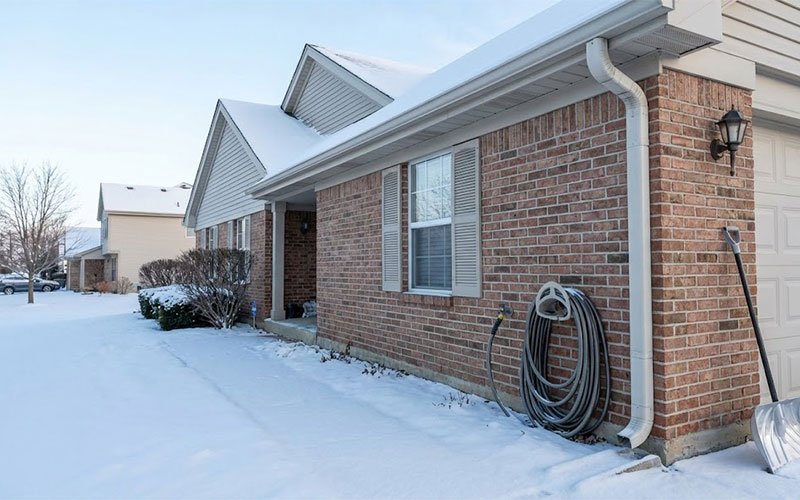
If you have lived in Will County for more than a year, you know the drill. One day it is 50 degrees and sunny; the next day, the “Polar Vortex” descends, and temperatures plummet to sub-zero.
Our Illinois winters are notoriously tough on houses. The freeze-thaw cycle can wreak havoc on your plumbing, your roof, and your foundation if you aren’t prepared.
At Norman Home Inspections, we see the aftermath of winter damage every spring. The tragedy is that most of it is preventable. Here is our essential checklist to protect your home before the first deep freeze hits.
1. The #1 Mistake: Garden Hoses
This is the most common cause of basement flooding we see. If you leave your garden hose attached to the outdoor faucet (hose bib) during freezing temperatures, the water trapped inside the hose expands. This pressure backs up into the pipe inside your wall and bursts it.
You often won’t know it happened until spring, when you turn the hose on to wash the car and flood your basement instead.
The Fix: Disconnect all hoses, drain them, and store them in the garage. If your home doesn’t have “frost-free” sillcocks, locate the shut-off valve inside your home and turn off the water to the outside.
2. The Sump Pump Discharge Line
In summer, you want that long black extension hose attached to your sump pump discharge to carry water far away from your foundation. In winter, that hose is a liability.
If water freezes inside that extension hose, it blocks the pipe. Your sump pump will try to pump water out, hit the ice block, and burn out its motor—or simply overflow into your basement.
The Fix: Remove the extension hose once temps drop consistently below freezing. Make sure the discharge pipe exiting the house has a downward slope so water can flow out and not settle/freeze.
3. The “Ice Dam” Defense
Ice dams occur when heat escapes your attic and melts the snow on your roof. The water runs down to the cold eaves and refreezes, forming a wall of ice. This wall traps water, forcing it back up under your shingles and into your attic.
The Fix: Keep your gutters clean! Clogged gutters make ice dams much worse. Also, check your attic insulation. If you have “hot spots” on your roof where snow melts quickly, you likely need better insulation or ventilation.
4. Give Your Furnace Room to Breathe
Your furnace is going to be running a marathon for the next four months. Don’t make it run with a mask on.
Check your furnace filter monthly. A clogged filter restricts airflow, forcing the system to work harder and increasing your energy bills. It can also cause the heat exchanger to overheat and crack—a dangerous carbon monoxide hazard.
5. Seal the Envelope
Walk around your home’s exterior. Look for gaps where pipes or wires enter the siding. Mice are looking for a warm place to spend the winter, and they can squeeze through a hole the size of a dime.
The Fix: Seal these gaps with steel wool and caulk. It keeps the cold air out and the critters away.
Preparation is Cheaper than Repair
Spending a Saturday afternoon on these tasks can save you thousands in deductibles and repairs later. Your home protects you from the elements; make sure you return the favor.
Worried about your home’s condition?
Get a comprehensive maintenance inspection from Norman Home Inspections.
📞 (815) 782-0544
🌐 www.normaninspections.com
📍 Serving Plainfield, Joliet, Naperville, and surrounding areas.